
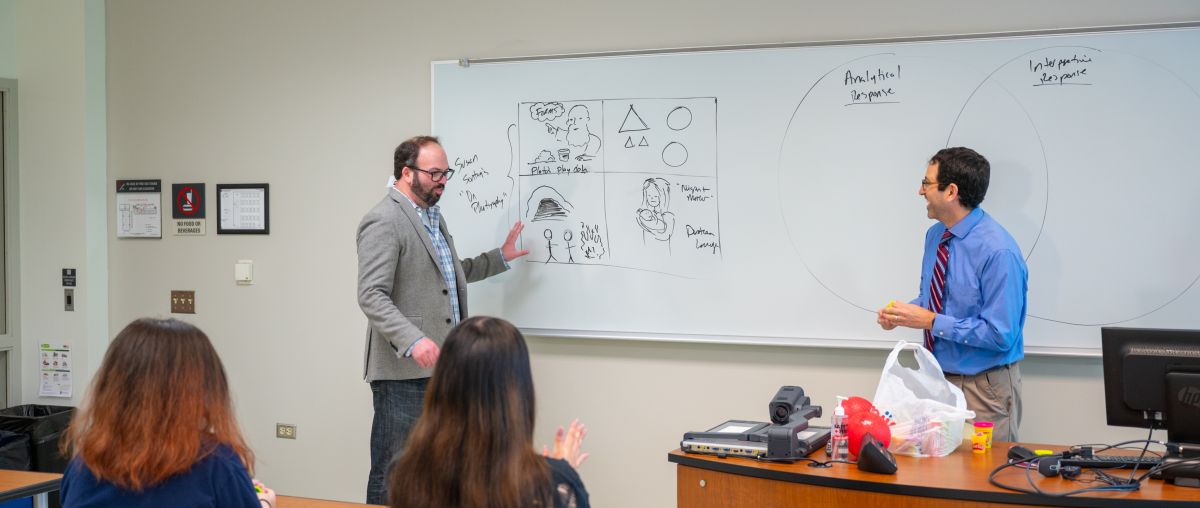
Both courses will be taught by two instructors at the same time, to foster dialogue, debate, and discussion. Both classes will be a part of a community where learners can engage one another in meaningful and memorable ways!
"Participating in a learning community at Waubonsee was an enriching educational experience for me. I had the opportunity to learn in a unique environment, where students could step away from typical classroom dynamics and grow together as a group with a shared educational goal." — Finch Kartheiser
Fall 2026 Course Offerings
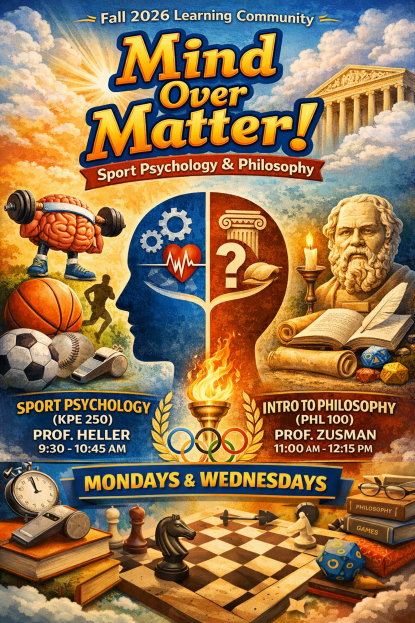
Mind over Matter! Sport Psychology & Philosophy
Do you love sports and games? Want to develop both your mind and body? This exciting learning community provides an opportunity to discuss factors that influence athletic performance and overall well-being. We will explore topics in kinesiology such as the psychological aspects of mental toughness, burnout, and group cohesion (KPE250) alongside some of the big questions in philosophy such as personal identity, free will, mind and body, ethics, and human flourishing (PHL100). Much of this learning will be done through playing games in class.
Enhance your athletic performance while learning to think deeply and critically about the world around you! Game on!
| Course Number | Course Title | Instructor | Days/Times |
|---|---|---|---|
| KPE250 | Sport Psychology | Heller, Dr. Emily | MW, 9:30am-10:45am |
| PHL100 | Introduction to Philosophy | Zusman, Steve | MW, 11:00am-12:15pm |
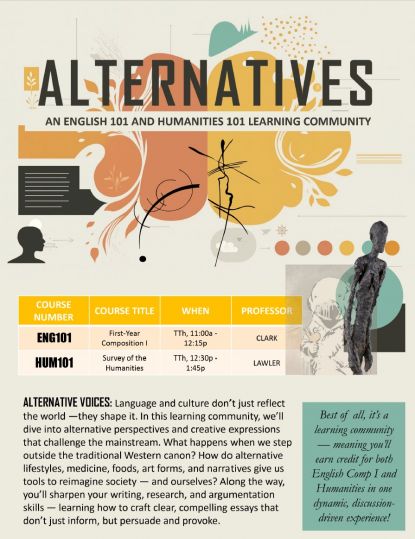
Alternatives — An English 101 and Humanities 101 Learning Community
Alternative Voices: Language and culture don't just reflect the world — they shape it. In this learning community, we'll dive into alternative perspectives and creative expressions that challenge the mainstream. What happens when we step outside the traditional Western canon? How do alternative lifestyles, medicine, foods, art forms, and narratives give us tools to reimagine society — and ourselves? Along the way, you'll sharpen your writing, research, and argumentation skills — learning how to craft clear, compelling essays that don't just inform, but persuade and provoke.
| Course Number | Course Title | Instructor | Days/Times |
|---|---|---|---|
| ENG101 | First-Year Composition I | Clark, Gary | TTH, 11:00am-12:15pm |
| HUM101 | Survey of the Humanities | Lawler, Dr. Aaron | TTH, 12:30pm-1:45pm |
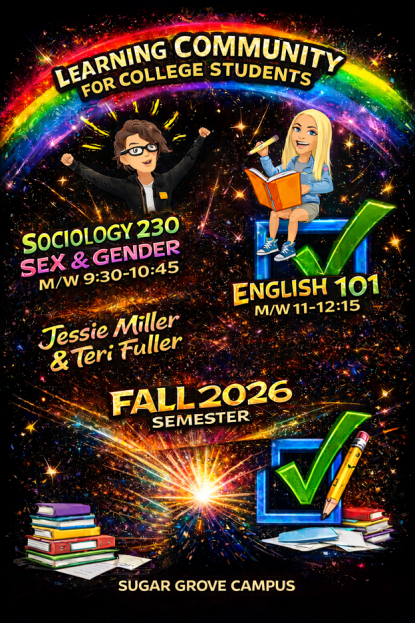
Sex and Gender & English Composition
| Course Number | Course Title | Instructor | Days/Times |
|---|---|---|---|
| SOC230 | Sociology of Sex and Gender | Miller, Jessie | MW, 9:30am-10:45am |
| ENG101 | First-Year Composition I | Fuller, Teri | MW, 11:00am-12:15pm |
| ENG099 | Supplemental First-Year Composition I | Fuller, Teri | MW, 12:30pm-1:20pm |
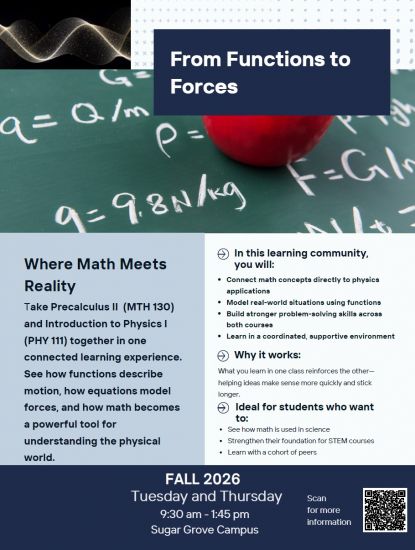
From Functions to Forces
Where Math Meets Reality
Take Precalculus II (MTH 130) and Introduction to Physics I (PHY 111) together in one connected learning experience. See how functions describe motion, how equations model forces, and how math becomes a powerful tool for understanding the physical world.
In this learning community, you will:
- Connect math concepts directly to physics applications
- Model real-world situations using functions
- Build stronger problem-solving skills across both courses
- Learn in a coordinated, supportive environment
Why it works:
What you learn in one class reinforces the other—helping ideas make sense more quickly and stick longer.
Ideal for students who want to:
- See how math is used in science
- Strengthen their foundation for STEM courses
- Learn with a cohort of peers
| Course Number | Course Title | Instructor | Days/Times |
|---|---|---|---|
| MTH130 | Precalculus II | Crawford, Mark | TTh, 9:30am-10:45am |
| PHY111 | Introduction to Physics I | Jindal, Dr. Pratima | TTh, 11:00am-1:45pm |
Unlock Math Confidence in a Learning Community
Blend together the content of MTH050 with the strategies of COL100 to give students the strongest start possible. By embedding success techniques directly into the learning experience, this learning community (MTH050 & COL100) aims to build students' confidence, strengthen their academic habits, and create a foundation for continued achievement in future courses.
| Course Number | Course Title | Instructor | Days/Times |
|---|---|---|---|
| MTH050 | Basic Mathematical Skills | Brown, Maribeth | TTh, 9:30am-10:20am |
| COL100 | Great Beginnings: College Life and Success | Morgan, Melissa | TTh, 10:25am-10:50am |
FAQs for Learning Community
What are Learning Communities?
Why should I take a Learning Community?
What do students say about taking Learning Communities?
Are Learning Communities extra work?
Are both instructors present in each other’s class?
How does this affect my course load?
